

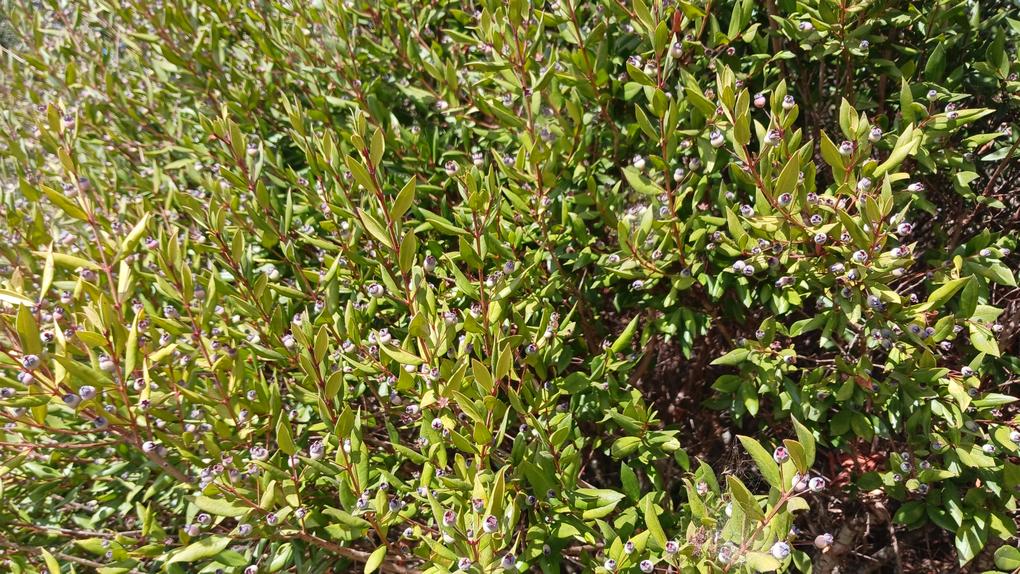
Myrtle – A Fragrant Classic with Symbolic Power
Myrtle (Myrtus communis) is an evergreen plant known for its fragrant leaves and white flowers. Originally from the Mediterranean, it has secured a firm place in gardens and herbal medicine through its versatile uses. Whether as a decorative shrub, in perfumery, or as a symbol of love, myrtle captivates with its beauty and symbolic power.
Appearance and Location
Myrtle is a bushy, compact shrub that can reach a height of up to three meters, depending on the location. In the Algarve, myrtle is not particularly demanding in terms of location; it is widespread but appreciates some shade.
The small, glossy, dark green leaves release an aromatic fragrance when crushed. In early summer, delicate, white to cream-colored blossoms with numerous stamens appear, which are particularly prized by bees and butterflies. After flowering, the plant develops dark blue to black berries, which are used in Mediterranean cuisine.
Symbolism and History
Since antiquity, myrtle has been considered a symbol of love, beauty, and purity. In Greek mythology, it was sacred to the goddess Aphrodite, which is why it plays a significant role in wedding rituals. Myrtle is also frequently found in Christian tradition as a symbol of purity. In many cultures, its branches are used in bridal bouquets or as headdresses, which has earned it the nickname "bridal myrtle."
Uses in Cuisine and Medicine
The berries are used in Mediterranean cuisine to flavor meat dishes or to make liqueurs. Sardinian Mirto, a liqueur made from myrtle berries, is particularly well-known.
During the distillation of myrtle essential oil, two different chemotypes are formed, depending on the myrtle's location. Here in the Algarve, the cineole chemotype oil is recognizable by its slightly greenish color. This essential oil possesses expectorant and anti-inflammatory properties and can be used effectively to treat respiratory ailments.
Myrtle oil of the myrtenyl acetate chemotype has a brown to reddish-brown color and originates primarily from Morocco. Myrtle is distilled in May/June, using fresh shoots with or without flowers.
Myrtle Hydrosol – Gentle Care for Skin and Eyes
The chemotype plays only a minor role in the distillation of this hydrosol. The scent is fresh and robust, with a spicy note. Its physical effects are diverse: anti-allergic, antiseptic, anti-inflammatory, immune-stimulating, expectorant, and analgesic.
Like the essential oil, myrtle water is suitable for treating respiratory ailments such as coughs and colds during the damp, cold season. It can be used undiluted as a nasal spray and has a decongestant effect. I personally like to use it externally on my nose and sinuses when I have a cold. For mouth and throat ailments, the hydrosol is suitable as a base for a gargling mixture.
In the Algarve, summers are hot, dry, and dusty, which can lead to irritated eyes, especially when combined with contact lenses. Applying a compress with cooled myrtle water to closed eyes is a real treat. It also provides relief when symptoms are caused by allergies.
Myrtle was already known as a beauty aid in ancient times. In France and Italy, myrtle water has been known as "angel water" since the 16th century. With its regenerative properties, it cares for a wide variety of skin types – from sensitive and dry skin to oily, blemished skin. Furthermore, it is suitable as a natural deodorant, either pure or mixed with essential oils.
Myrtle also has a positive effect on the psyche. As a room or pillow spray, in an aroma lamp, or an aroma diffuser, it unfolds a balancing, relaxing, and calming effect.
Myrtle, with its long tradition, is truly a gift of nature and will hopefully continue to serve us well in the future.
This article was published in Aromareport 30 of Aromaforum International e.V.